

This article is adapted from Thought Leadership in Practice 2026.
In our inaugural thought leadership study, released last year, we diagnosed fragmentation in corporate ownership of thought leadership. A majority of 1,000 respondents reported multiple functions involved in the process—including Marketing, Sales, and Strategy.
A year on, the question of who actually runs thought leadership remains all over the place.
The lack of a consistent functional home speaks to the multidisciplinary nature of thought leadership. Successful programs need coordination across teams, including both client-facing and support employees.
No function dominates
Thought leadership continues to live in the seams between functions: on average, three functions are involved per organization.
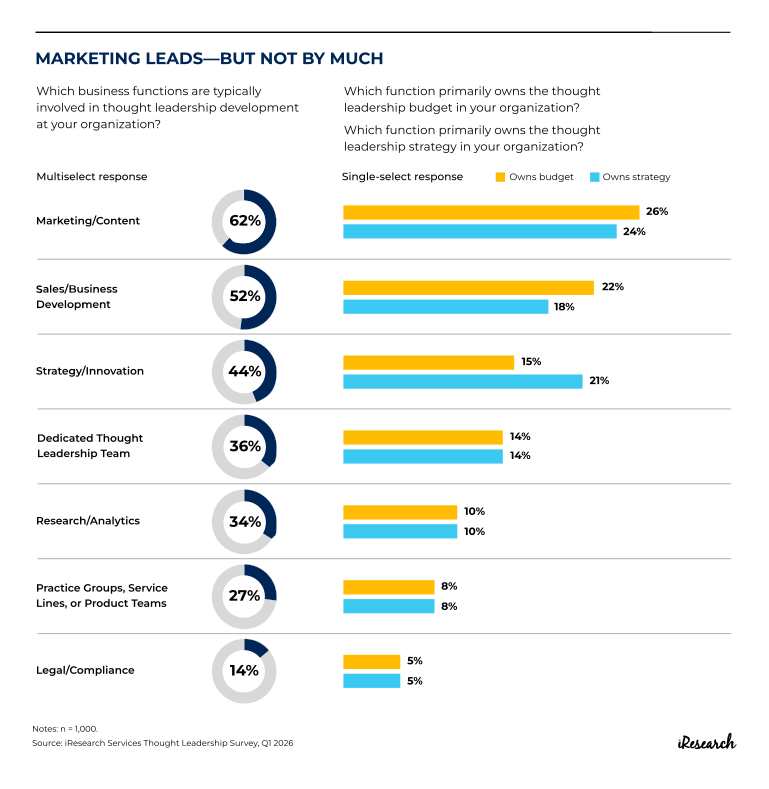
Marketing (62%) and Sales (52%) remain the most common functions involved, which is unsurprising given thought leadership’s communications origins and commercial importance. More telling is only a third (36%) of 1,000 respondents report having a dedicated thought leadership team. So, for most organizations, thought leadership is a shared responsibility rather than an owned function.
But the composition of that collaboration may be shifting. Strategy & Innovation involvement climbed six percentage points year over year to 44%, while Marketing’s share dropped by the same margin. The reshuffle is small in absolute terms, but the direction matters: more organizations are treating thought leadership not as a marketing subfunction but a strategic capability that belongs in the room where the business is being shaped.
Ownership of budget and strategy is fragmented
Involvement is one thing. Ownership is another. And when we asked who actually owns the budget versus who owns the strategy, a far messier picture emerged.
A majority of thought leadership practitioners (54%) report that budget ownership for thought leadership sits in one function and strategy ownership sits in another. Whether that reflects a deliberate separation of responsibilities or simply an organizational accident is difficult to tell from the data alone.
Figure 1 maps function involvement against ownership of each budget and strategy. A notable discrepancy: while 36% of respondents report having a dedicated thought leadership team involved in the process, just 14% say that team owns the strategy and 14% say it owns the budget. Even when a thought leadership team exists, it’s more likely to play a supporting role than a governing one, by helping to execute programs that are ultimately directed or funded elsewhere in the organization.
Lean teams, stable headcount
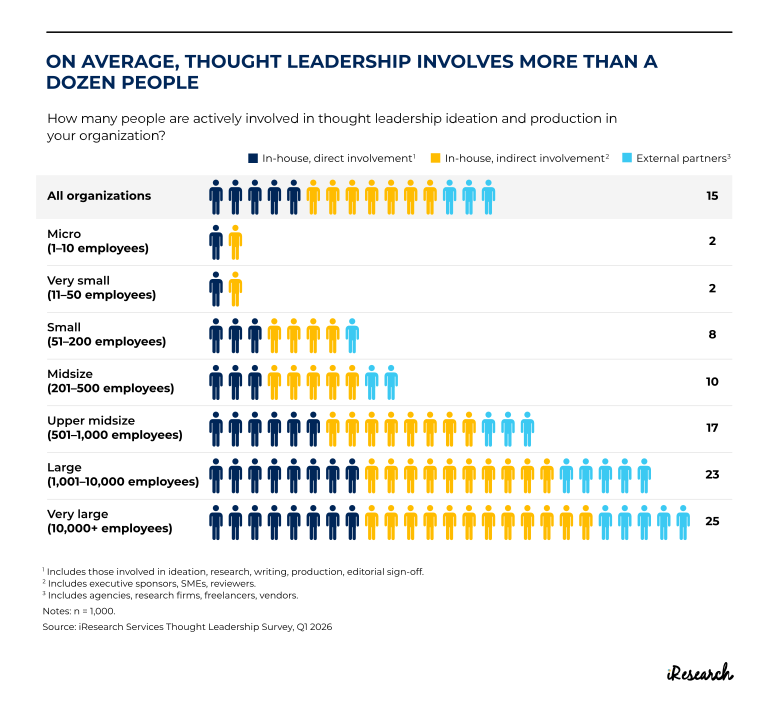
For the second year in a row, we asked respondents how many individuals are involved in thought leadership ideation and production at their organization. Little has changed in the past year: the average thought leadership function still operates with roughly 15 people, and team size is generally proportional to company size (Figure 2).
Very large organizations are the notable exception. Over the past year, they added an average of four team members, growing to 25 in headcount, from 21. The largest organizations are scaling up; the rest are holding steady.
Figure 2:
But holding steady does not necessarily mean steady workloads. Thought leadership is typically produced by small teams expected to manage a wide range of responsibilities—and that pressure shows up in the data.
A quarter (25%) of respondents cite a lack of internal capabilities as their thought leadership team’s primary challenge, and another 21% point to time constraints.
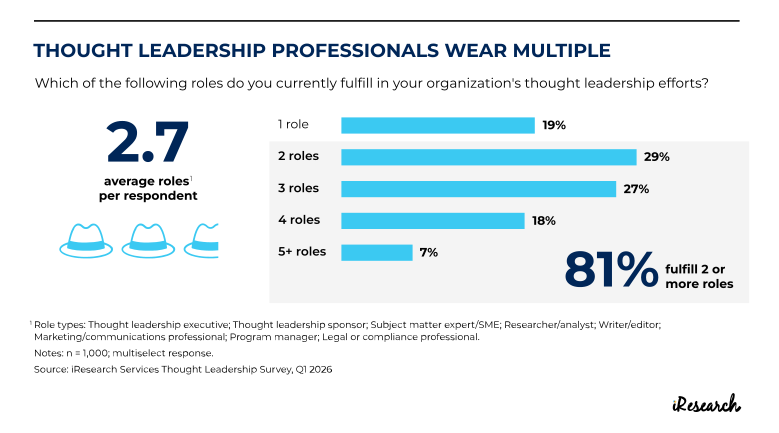
These professionals likely feel stretched because, on average, they report playing 2.7 roles spanning ideation, execution, and coordination (Figure 3). Only 19% of respondents fulfill a single role, while 25% fulfill four or more.
Figure 3:
What this means for your thought leadership
So there’s a reason every person who works in thought leadership has had a unique path into it: the work is by nature multidisciplinary. Here’s how to put these findings to use.
Audit whether your ownership structure is intentional.
For most thought leadership practitioners (54%), budget and strategy sit in different functions. That may be a deliberate separation—commercial sponsorship on one side, editorial direction on the other—or it may simply be the result of how the pieces fell over time.
Split ownership can work well when responsibilities and coordination are clearly defined as part of the operating model. It falls apart when accountability is ambiguous or assumed rather than explicitly defined.
The goal is not necessarily to consolidate ownership by default, but to determine whether the current arrangement is the one you would intentionally build today. If it isn’t, the next question is who has the authority to redesign it.
Treat thought leadership as a people capability.
The top challenges practitioners name are capability gaps (25%) and time constraints (21%). Neither can be solved by better software or a new brief format. These are fundamentally people and process challenges.
Organizations with mature thought leadership functions treat thought leadership as a people-led capability. They build the infrastructure for cross-team collaboration, establish clear editorial and governance models, and develop talent and relationships that allow the work to move efficiently through complex environments.
Read the full report on which this article was based at Thought Leadership in Practice 2026.
About the research
This report is based on a comprehensive survey of 1,000 professionals directly involved in their organization’s B2B thought leadership. The research was fielded in Feb–Mar 2026 by iResearch Services.
