


This article is adapted from Thought Leadership in Practice 2026.
Who runs thought leadership is only half of the governance story. An organization can have tidy reporting lines, ad educated thought leadership team, even a healthy budget—and still produce reactive thought leadership. No strategy, no repeatable process, no measurement. All vibes.
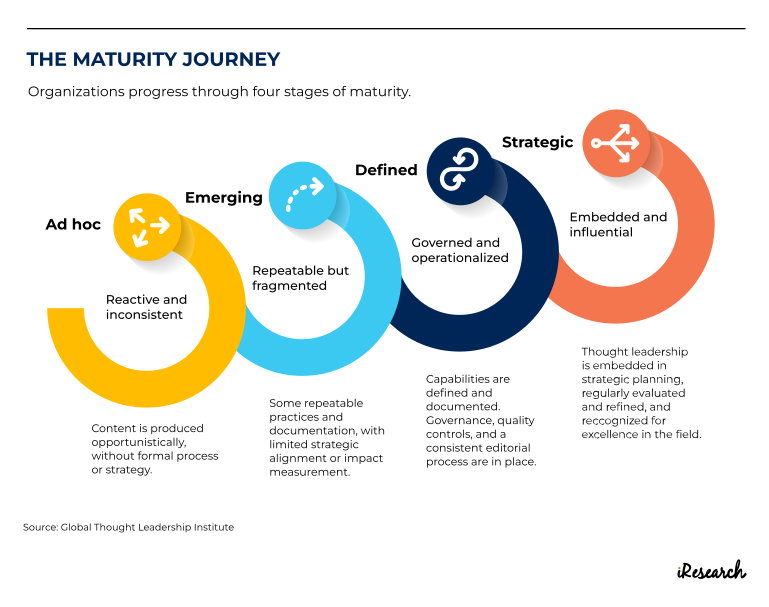
In business, we tend to talk about gaining maturity not as an act of leaving behind a misspent youth but in terms of operational maturity: how repeatable, embedded, and refined a team’s processes are. For the second year of our research study on the thought leadership function, we added a question asking 1,000 professionals to assess how mature their organization’s thought leadership practice is according to the four-stage maturity framework created by the Global Thought Leadership Institute (Figure 1).
Figure 1:
The distribution of our 1,000 respondents across the four tiers is revealing (Figure 2). Only 26% say their thought leadership organization has reached strategic maturity; 29% are defined, 37% emerging, and 8% ad hoc. Maturity, by this measure, remains the exception rather than the rule.
Figure 2:

Size helps, but only to a point. Strategic maturity is almost nonexistent in organizations with fewer than 50 employees (Figure 3). But beyond that threshold, strategic maturity is well within reach: 28% of practitioners at small organizations (51–200 employees) describe their thought leadership maturity as strategic. At the other end of the spectrum, maturity plateaus at the 1,000-employee threshold and above.
Figure 3:

Don’t wait for scale to pursue maturity.
Maturity is a function of operational choices rather than organizational size—and is achievable at almost any scale. Small organizations (51–200 employees) report strategic maturity at higher rates than midsize ones, while the very largest organizations are no more likely to be mature than those a tenth of their size. Scale may create more resources and visibility, but it does not automatically produce strong governance, clear ownership, or disciplined operating practices. If your organization is waiting to “get bigger” before investing in governance and process, survey says that’s the wrong approach.
Read the full report on which this article was based at Thought Leadership in Practice 2026.
About the research
This report is based on a comprehensive survey of 1,000 professionals directly involved in their organization’s B2B thought leadership. The research was fielded in Feb–Mar 2026 by iResearch Services.
