

This article is adapted from Thought Leadership in Practice 2026.
Distribution may take place after thought leadership is developed, but that does not mean it should be treated as an afterthought.
Organizations that plan for distribution earlier report more business outcomes from their thought leadership. Yet distribution remains the weakest operational capability in thought leadership, even among mature organizations.
Distribution is the weakest link
For many thought leadership practitioners, the hardest part of thought leadership begins after the content is completed. Nearly a quarter (24%) of respondents identify distribution as their organization’s biggest capability gap, while just 6% call it their greatest strength—the lowest figure of any practice measured.
The pattern holds across maturity tiers. Distribution is the top-ranked capability gap for ad hoc organizations (30%), emerging (24%), and defined (25%). Only at strategic maturity does another challenge overtake distribution, with content strategy narrowly edging out distribution (25% vs distribution at 20%). Even the most mature organizations are still working on mastering distribution.
One reason is that, for most organizations, distribution is an afterthought. Only 33% of organizations begin planning for distribution during ideation (Figure 1). Most wait until research or content development is already underway, and 13% only think about distribution after the content is complete. In other words, for two-thirds of organizations, distribution is treated as a logistics problem to figure out once the work is in progress—rather than a strategic input shaping the work itself.
That sequence has consequences. Organizations that begin planning distribution during ideation report more measurable business outcomes than those that wait until content is complete: they are 16 percentage points more likely to report higher brand visibility (61% vs 45%) and 8 percentage points more likely to report new business growth (57% vs 49%). The teams that think about audience and channel strategy earliest are also the ones most likely to see their thought leadership break through.
Figure 1:

Not all channels create equal value
Most organizations rely on a relatively small set of distribution channels—3.2, on average. Three dominate the mix: own websites (59%), LinkedIn (55%), and email newsletters (46%) (Figure 2).
Figure 2:
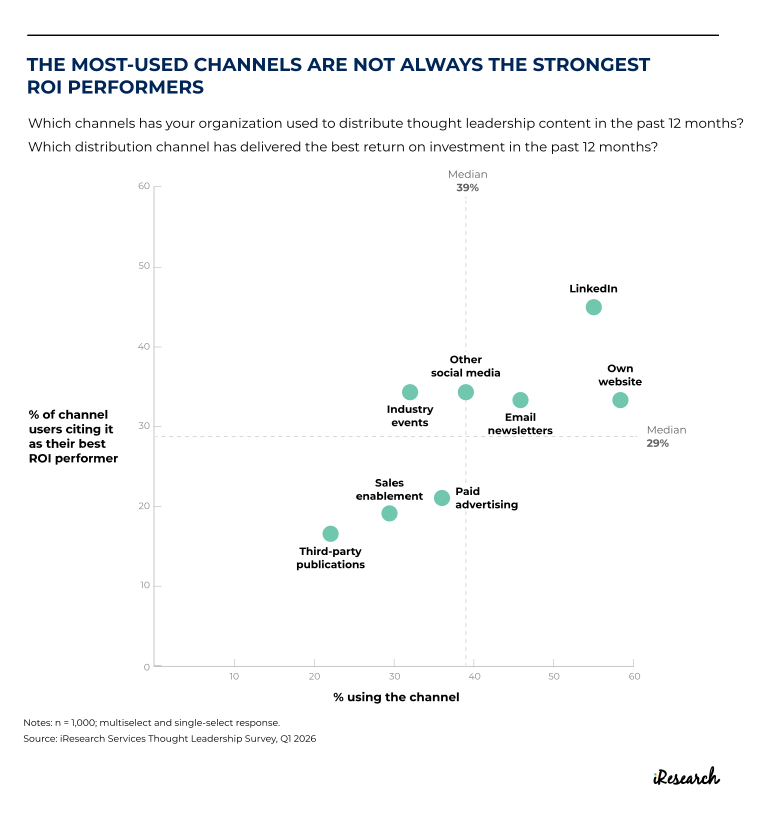
But channel adoption and channel performance aren’t the same thing. Only one-third (33%) of respondents say their organization’s website delivers the strongest returns, even though it is the channel with the widest adoption. The runner-up in adoption, LinkedIn, is the runaway leader in ROI: among those who use the platform for distribution, 45% say it delivers their best return—well ahead of any other channel.
LinkedIn has a reported 1.3 billion users, with 310 million active daily. It’s a standard part of the B2B marketing toolkit: of course there’s the final PDF report to email to clients, but there’s also a set of LinkedIn carousels and text snippets to share with senior leaders. For anyone aspiring to be a thought leader, a LinkedIn profile is socially mandatory.
And it makes sense, right? Thought leadership is about connecting ‘idea people’ with those in need of ideas. The rise of business social media since the early 2010s has created a distribution channel for individual voices alongside corporate ones. Research suggests that people often find individual human voices more credible than organizational voices, especially when the message feels personal, authentic, or comes from a peer or customer rather than a company representative.
For a no-nonsense take on distribution best practices, see Saturation, Strategy, and Staying Power: A Conversation with iResearch Services SVP of Global Marketing Madelaine Oppert.
To gate or not to gate?
Today, nearly half (48%) of respondents say their organization takes a mixed approach to gating—that is, requiring contact information to access—their thought leadership content (Figure 3). The 34% of respondents that don’t gate their content are likely prioritizing brand awareness and reach, while the 13% that gate all their content are likely using thought leadership primarily for lead generation. The mixed-model majority is doing both: selectively gating the assets built to convert, and leaving the rest to travel.
Maturity, again, shows up in the texture. Ad hoc thought leadership organizations are the most likely to leave most of their content ungated (52%)—a defensible choice when the priority is reach. Strategic organizations, by contrast, are two to three times more likely to say their gating approach varies by situation (10% versus 3–5% at other maturity levels). For mature programs, gating appears to be less of a fixed doctrine and more a strategic decision that varies based on asset, audience, or campaign objective.
Figure 3:

What this means for your thought leadership
Thought leadership does not automatically create impact. The organizations reporting the most business outcomes are not necessarily producing more content—they are making intentional decisions about how that content reaches audiences, as well as what role it is expected to play.
Move distribution planning to the starting line.
Only a third of programs plan distribution at ideation, but those that do report more business outcomes. When distribution is part of the brief, the work gets shaped around the channels, audiences, and objectives it needs to serve. When it’s bolted on afterward, teams are left to retrofit a finished asset into a channel and format that it was never designed for. It can be as simple as asking “where will this land?” in the same conversation that sets the research question.
Treat distribution as a portfolio, not a checklist.
Our research shows organizations rely on a small set of channels—three, on average—and the same handful of owned and social channels retain the top spots. But those channels serve different purposes. LinkedIn amplifies visibility and professional influence. Owned websites are where the work lives permanently and gets found later. Newsletters reinforce existing audiences. Events create depth beyond a screen.
Experienced thought leadership professionals adapt content formats, messaging, and access models to the role each channel needs to play.
Read the full report on which this article was based at Thought Leadership in Practice 2026.
About the research
This report is based on a comprehensive survey of 1,000 professionals directly involved in their organization’s B2B thought leadership. The research was fielded in Feb–Mar 2026 by iResearch Services.
