
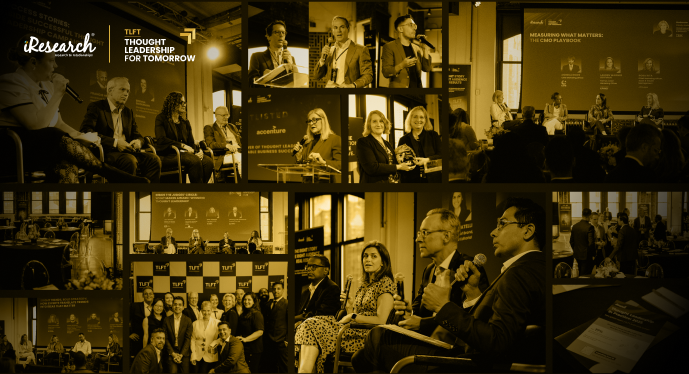
From macro strategy and AI disruption to creative spark and campaign execution, TLFT 2025 tackled it all.
Seven years. That’s how long a breakthrough idea used to last in the market. Today? Try three—if you’re lucky. Welcome to the new reality of thought leadership.
This reality brought industry leaders together at iResearch Services’ third annual Thought Leadership For Tomorrow (TLFT) conference in May 2025 to tackle the nagging question hanging in the air: How do you create thought leadership that actually leads thinking?
The day-long event, set against the backdrop of New York’s iconic Flatiron District, comprised six sessions that offered attendees a rare chance to immerse themselves in the full life cycle of thought leadership—from its earliest conceptual stages to the metrics that prove its value. More than 100 speakers and attendees explored how top brands are navigating a crowded content landscape, harnessing new tools, and building thought leadership that moves the needle on relationships, reputation, revenue, and real-world impact.
The attendees also got a sneak peek of Thought Leadership in Practice: Insights from 1,000 Industry Experts, a new survey report from iResearch Services offering original data and analysis of the thought leadership industry.
Here’s a look back at the key themes and standout ideas from TLFT 2025.
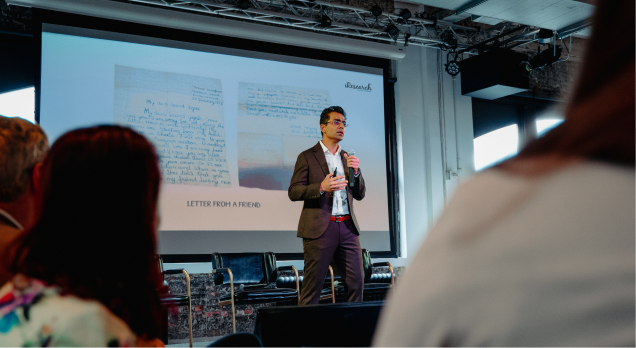
Keynote from Yogesh Shah
TLFT 2025 opened with a keynote speech by iResearch Services CEO Yogesh Shah, in which he traced his family’s long lineage of entrepreneurship from his 6th great grandfather Lallubhai in Gujarat, India, to himself on the stage in New York. Shah painted a vivid picture of Lallubhai, a farmer who faced drought, famine, and failed crops before making the difficult decision to relocate his family—a choice based on carefully weighing evidence from multiple sources, from word of mouth to government announcements.
Shah used this historical lens to highlight a stark contrast: while evidence-based decision-making was crucial two centuries ago, today’s information landscape has been flooded with what he termed “sand data”: unfiltered, unedited content that spreads without fact-checking. He argued that this phenomenon has contributed to election results, stock market swings, and public disorder, but expressed optimism that we’re approaching “peak sand data” as people become more discerning about information quality.
He ended with three key insights from iResearch Services’ new Thought Leadership in Practice report, which underscored the day’s themes:
- Thought leadership is delivering measurable results, with 53% of organizations attributing new business growth to thought leadership.
- Budget ownership remains fragmented across business functions, creating challenges for strategic alignment.
- The industry lacks consensus on measurement standards, with practitioners tracking everything from engagement metrics to press coverage.
Shah positioned these findings as both validation of thought leadership’s impact and a call to action for greater collaboration and standardization across the industry.
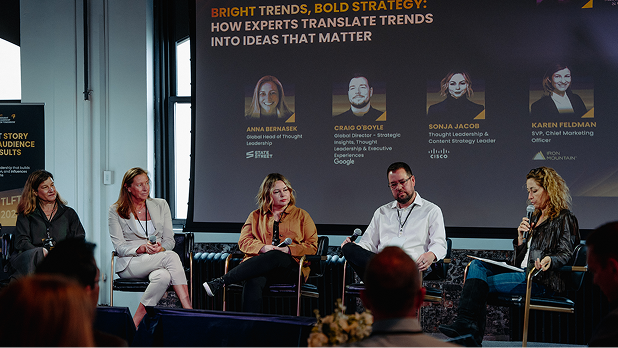
Bright trends, bold strategy
The first panel explored how strategy and timely thought leadership intersect. Moderated by Lucia Rahilly, Global Editorial Director & Deputy Publisher at McKinsey & Company, the session featured a lively discussion on how leading organizations are using thought leadership to navigate global shifts, differentiate their brands, and publish content that aligns with long-term business goals.
This session touched on the shrinking shelf life of thought leadership, with Karen Feldman, SVP and Chief Marketing Officer at Iron Mountain, commenting that, where an idea may once have had a seven-year lifespan, aiming for even three years may be ambitious in today’s climate. This observation sparked a broader discussion on sustaining content relevance and increasing speed to market. Feldman recommended tying content to flagship marketing moments and using cross-functional teams for buy-in and investment.
Anna Bernasek, Global Head of Thought Leadership at State Street, emphasized that even long-range planning has to be flexible. “You may plan evergreen content six months in advance,” she said, “but no matter what, you’re going to tailor it to the day.”
The panel also took on the question of how bold thought leadership should be. Sonja Jacob, Thought Leadership and Content Strategy Leader at Cisco, made the case for taking risks: “We need to push our internal thought leaders to be more provocative.” As the panel debated what “provocative” looks like across different industries, Jacob noted that internal resistance can be overcome: “You can mitigate the impact of how bold something is by socializing ideas.”
When the discussion turned to AI, speakers shared practical examples of how they’re using it to enhance their work. Craig O’Boyle, Global Director of Strategic Insights, Thought Leadership, and Executive Experiences at Google, highlighted AI’s role in enabling greater breadth and variety in storytelling, as well as accelerating the repurposing of core ideas into formats such as video. Jacob described using AI to scope research, identify credible sources, and conduct preliminary message testing. Bernasek acknowledged that while the possibilities are exciting, many sectors are still constrained by compliance and regulation.
Looking ahead, Feldman raised the question of whether the labor intensity of working with data might ever be reduced to “zero-touch.” O’Boyle concluded the discussion with a reminder that, despite the hype, the future of AI will still rely on human discernment: “It’s coming back to the humans. With all of the rapid pace of change around AI right now, it comes back to the human in the room making strong decisions.”
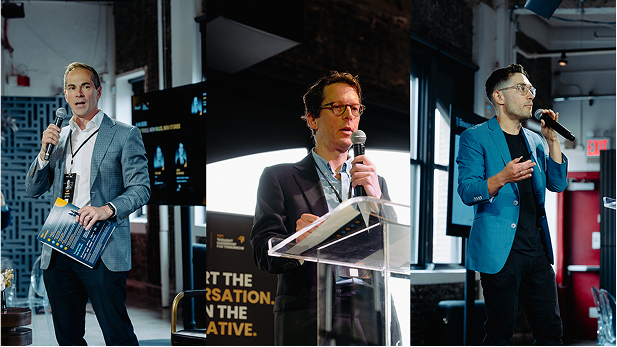
AI in 2025: New tools, new rules, new stories
As artificial intelligence continues to influence the thought leadership industry, TLFT 2025 set out to tackle some of the promises and pitfalls of integrating AI across the content life cycle. Moderated by Jeff Potter, Head of Advisory Insights at KPMG US, this session included presentations from Joe Lazer, CMO of Peppercontent, and Josh Rosenfield, Editorial Director for Global Thought Leadership at PwC.
While the tools and terminology may be evolving quickly, one theme came through clearly: writing is still thinking—and thinking still needs humans.
In his presentation, Lazer warned against the creeping mediocrity of overreliance on generative AI tools. “AI pulls us toward safe ideas and uninspired prose,” he said, describing what he called “the vortex of the mid.” His message was not anti-AI, but rather a call to use it strategically and critically: as a research assistant, a brainstorming partner, or a repurposing engine. When used well, he suggested, AI becomes “like a tiny production team inside your computer,” helping marketers and thought leaders atomize and extend good ideas into new formats at scale.
Rosenfield took a pragmatic view, advocating for experimentation with intent. He acknowledged the uncertainty many organizations face around which use cases are truly worthwhile and proposed a structured approach. His framework maps tasks according to business impact and the extent to which AI can improve them. Rosenfield emphasized the need for patience, suggesting that while AI’s potential is real, its current capabilities still require significant human oversight. “Expect to be disappointed for a while,” he said, but be prepared for once-impossible results down the line.
Together, Lazer and Rosenfeld stressed that the most effective use of AI is not to replace human creativity but to augment it. In their discussion, they also touched on the challenges of transparency, attribution, and disintermediation in a world where AI increasingly determines how audiences discover and engage with content.
As the session closed, the consensus was clear: AI will be a powerful part of thought leadership’s future—but only when paired with editorial discernment, strategic clarity, and a willingness to experiment beyond the hype.
Beyond words: Creating thought leadership that drives real-world change
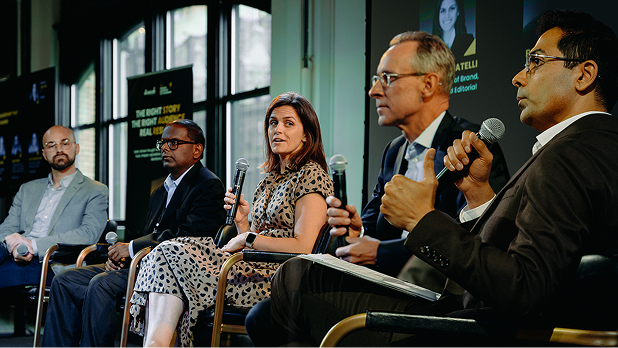
This roundtable focused on the “so what” of thought leadership—how to move beyond publishing content for content’s sake, and instead create work that drives decision-making, action, and change. iResearch CEO Yogesh Shah moderated the conversation, and the panelists shared their perspectives on what separates good thought leadership from great.
The value of specificity and knowing your audience was a panel-long theme. Melissa Catelli, Global Head of Brand, Content and Editorial Strategy at AECOM, underscored the importance of precision, observing that “the broader the topic, the less likely readers are to act.” Catelli recommended that thought leaders treat every piece of content as capable of inspiring a specific decision. Peter Linder, Head of Thought Leadership for North America at Ericsson, agreed, likening effective thought-leadership strategy to curating a multicourse feast of insights, research, and facts that address not just the “so what,” but also the “now what.”
Delivery is also important, and Aijaz Hussain Shaik, Senior Director of Thought Leadership and Research at Empower, suggested that teams spend as much time, budget, and strategic thinking on their content distribution needs as content ideation. Both Catelli and Linder spoke to the power of one-to-one (or one-to-few) conversations: while broad reach is important, some of the best-performing content is still delivered in person, in conversation at industry events.
Throughout the session, panelists reiterated the importance of authenticity. Hussain Shaik highlighted the value of credible, lived expertise, while Catelli advocated for content that earns confidence, recognizing that readers consult multiple sources before making a decision. Lucas Rivers, VP, Thought Leadership, Content & Communications in the Global Sustainability Office at Morgan Stanley shared his perspective on trust, and Linder suggested that “people are starting to forget what thought leadership really is,” adding that the most important role of a thought-leadership functional leader is to understand the customer better than anyone else.
The panel’s message was clear: in a saturated market, thought leadership needs to say something not just smart but specific, timely, and confidently backed by data.
Measuring what matters: The CMO playbook
The fourth session of the day brought together three chief marketing officers to tackle one of the most enduring challenges in thought leadership: how to prove its value. Moderated by Cindy Anderson, Global Executive for Thought Leadership Engagement and Eminence at the IBM Institute for Business Value, the conversation explored different philosophies, tools, and organizational dynamics that shape how marketers demonstrate value.
The panel opened with reflections on how to gain internal support for thought leadership measurement, especially in organizations where ROI can be elusive. Monica Rowe, Chief Marketing Officer at Care, called relationships the “golden currency” of thought leadership. She argued that influence is built through trust, and that positive business outcomes often stem from this foundation—even if they aren’t always immediately quantifiable.
Lauren Wagner Boyman, Partner and CMO at KPMG, described how different formats and types of content contribute to conversion paths. Rosa Rita, CMO for Asset and Wealth Management at J.P. Morgan, expanded on this with a focus on customer journey mapping. “The role of marketing,” she noted, “is to get that person to take the action”—and that means understanding which touchpoints are most likely to correlate with ROI.
Rowe, in contrast, spoke about mapping less tangible (but no less important) outcomes: the ripple effects of content on long-term relationships, stakeholder sentiment, and internal reputation. Influence often shows up later, in indirect ways, she said.
The panel also addressed the impact of generative AI and evolving search behaviors. As tools like generative engine optimization (GEO) shift how content is surfaced and consumed, the consensus was that quality content continues to rise to the top. While informative and substantive thought leadership may once have been buried in search results, this content may now appear more prominently in AI-driven outputs. Investing in depth and clarity still matters, the panelists agreed —perhaps more than ever.
Success stories: Inside effective thought leadership campaigns
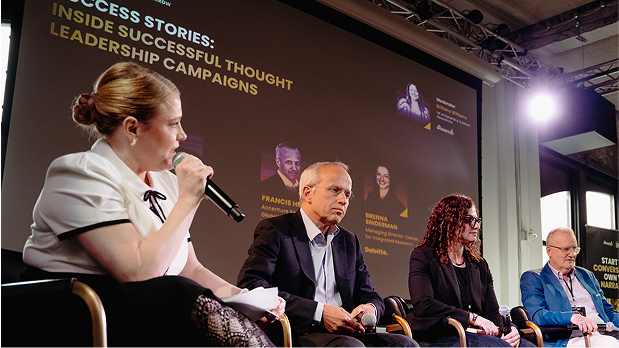
Moderated by Brittany Williams, VP of Editorial and Content Operations at iResearch Services and the TLFT 2025 emcee, this session dug into three of the year’s most effective thought leadership campaigns, as well as the organizational approach behind them. Panelists shared how initiatives moved from concept to execution, highlighting governance models and strategies that delivered successful campaigns.
Jonathan Dahl, VP and Chief Content Officer at Korn Ferry, described his firm’s streamlined governance: “We have a news meeting once a week that partners can attend, but otherwise the reviews are minimal.” This approach enables faster decision-making and reduces bureaucratic bottlenecks that often slow content production.
In a short presentation, Dahl showcased how Korn Ferry transformed its podcast from 300 views to 75,000 per episode by treating it like professional media rather than typical corporate content. “You’ve got to work with the people who really know what they’re doing,” he explained, highlighting that Korn Ferry’s CMO is an Emmy Award-winning host and the team focuses on timely headlines, opening skits, movie clips, and bloopers.
Brenna Sniderman, Managing Director of Deloitte’s Center for Integrated Research, emphasized helping subject matter experts refine their research scope in her discussion of thought-leadership governance. “Never go into a research project with a methodology in mind,” she advised. “The most underappreciated thing about research is figuring out what the actual question you’re trying to ask is.” This philosophy proves central to her team’s approach of prioritizing content quality over quantity.
In her mid-panel presentation, Sniderman gave an overview of Deloitte’s multiyear Tech Value research initiative, examining what combinations of technology investments, strategy, and human capital most impact company success. The project used sophisticated methodology including 10K statements, secondary data analysis, primary surveys, and qualitative interviews.
Francis Hintermann, Global Managing Director of Accenture Research, shared insights from Accenture’s Destination Net Zero research analyzing companies’ climate goal progress. The project demonstrated strategic balance between public and private insights—publishing broader statistical data publicly while reserving company-specific analyses for private client discussions. The project also won recognition as the inaugural winner of the “Thought Leadership for Sustainable Development Award” during the 2025 TLFT Awards, presented during the closing session of TLFT.
Inside the judges’ circle: What makes award-winning thought leadership
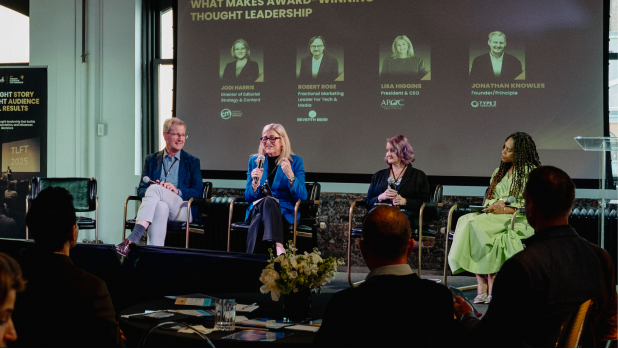
The day concluded with insights from the distinguished panel of judges who evaluated entries for the inaugural TLFT Awards. Head Judge Ty Heath, Director of Market Engagement at LinkedIn’s B2B Institute, moderated the discussion alongside judges Jodi Harris, Director of Editorial Strategy & Content at the Content Marketing Institute; Lisa Higgins, President & CEO of APQC; and Jonathan Knowles, Founder & Principal at Type 2 Consulting.
In a short roundtable, the judges shared their evaluation frameworks and discussed what separates good thought leadership from great. The winning entries successfully positioned their organizations as authoritative voices while creating genuine value for their audiences and industries.
Inaugural TLFT Awards winners
The inaugural Thought Leadership for Tomorrow Awards recognized excellence across multiple categories:
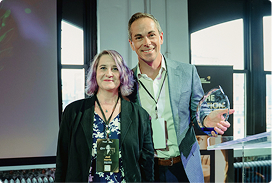

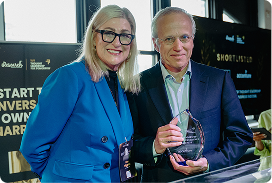

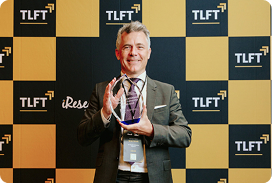


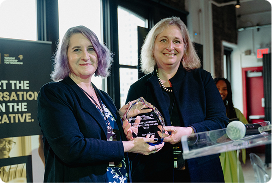
The awards highlighted the diversity of approaches to effective thought leadership, from KPMG’s interactive AI guidance tool to Elsevier’s framework for measuring university impact. Accenture’s multiple wins demonstrated the power of comprehensive research methodology and clear commercial outcomes.
Closing thoughts
Across each session and countless conversations, TLFT 2025 spotlighted the challenges—and opportunities—facing thought leadership today. From strategic foresight, to creative execution amid AI disruption, to meaningful measurement and findings, one thing was clear: delivering thought leadership requires agility and an appetite to learn.
Follow iResearch Services and our team on LinkedIn for more insights on the topics discussed at TLFT 2025 and Thought Leadership in Practice: Insights from 1,000 Professionals.
