
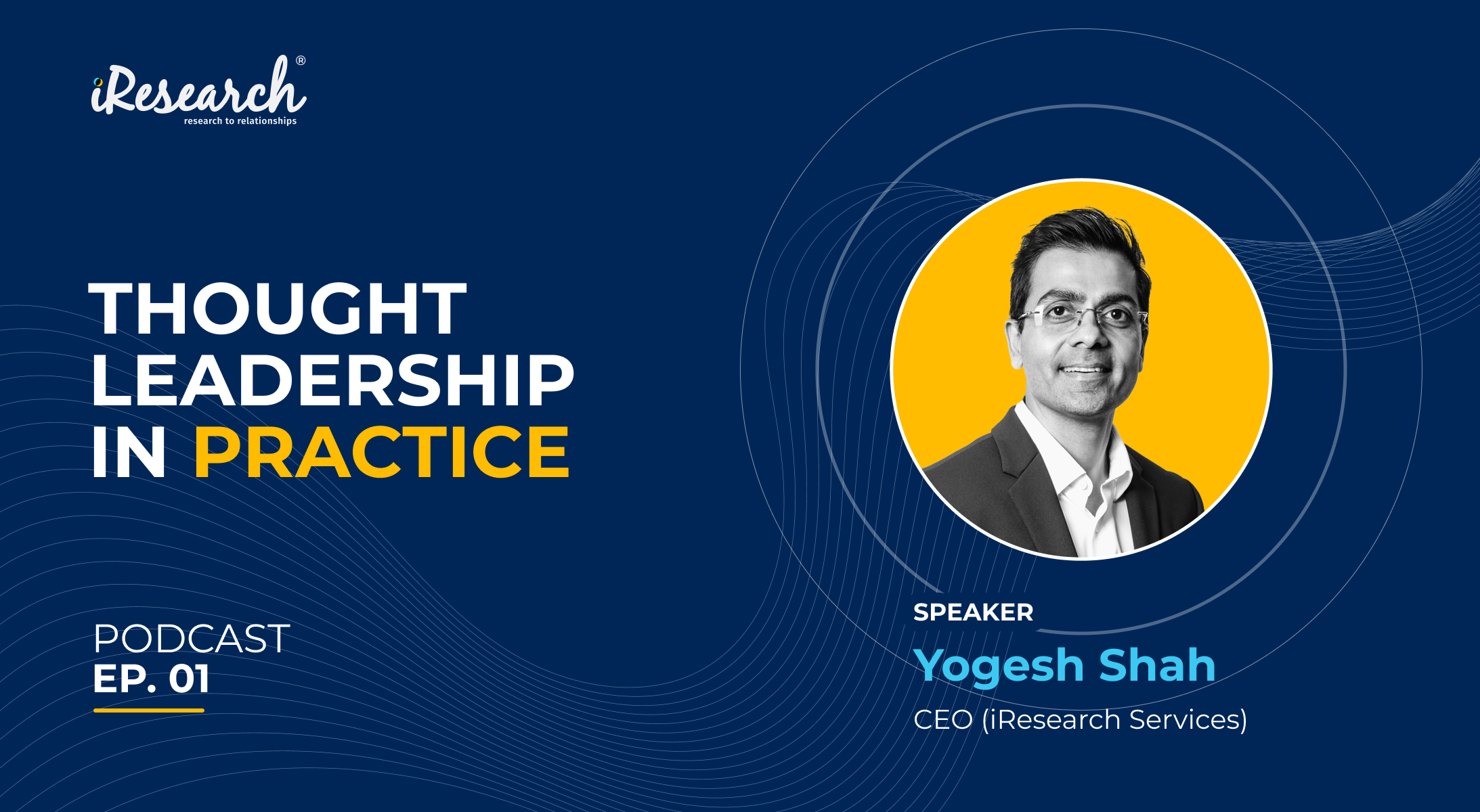
In this first episode of Thought Leadership in Practice, iResearch Services’ CEO Yogesh Shah sits down with VP of Editorial & Content Operations Brittany Williams to unpack insights from a global survey of 1,000 thought leadership professionals. Together, they explore how far the discipline has matured, where responsibility should lie within organizations, and why research-backed originality remains the true differentiator. From governance challenges to format choices and long-term measurement, this conversation offers C-suite leaders practical direction for building thought leadership that delivers both influence and impact.
Key Takeaways
- Governance matters: Only 17% of organizations have dedicated thought leadership teams with budget ownership—fragmentation continues to hold many brands back.
- Format follows value: Video is the most produced medium, but executives still prioritize sharp, evidence-based writing and originality over author or brand.
- Think long-term: Thought leadership is not a campaign but a trust-building discipline; measurement must reflect influence over time, not quick wins.
- Research is non-negotiable: Proprietary insights separate strong thought leadership from the “sea of sameness,” driving credibility, differentiation, and business impact.
Brittany Williams in conversation with Yogesh Shah
Brittany Williams: Hello everybody, and welcome to the podcast Thought Leadership in Practice, presented by iResearch Services. My name is Brittany Williams, and I’m the Vice President of Editorial and Content Operations at iResearch. I’m joined today by our CEO, Yogesh Shah, to discuss our latest publication, which is—funnily enough—titled Thought Leadership in Practice, with insights from 1,000 industry experts.
Yogesh, when you started iResearch in 2008, what was the thought leadership landscape like compared to what our research revealed in 2025?
Yogesh Shah: Back in 2008, thought leadership wasn’t really a household name within most brands. People liked to talk about it, but it was a bit like the Wild West. Some organizations were experimenting with it, but few treated it as a strategic objective. Most of what we saw were opinion-led pieces—white papers with limited data, structure, or research.
Since then, thought leadership has matured into a discipline. Many leading brands now have a dedicated function for it, where it’s managed strategically and contributes across the company. So today, there’s more strategy, more accountability, and much more structure compared to 2008.
Who’s in charge? The fragmentation challenge
Brittany: I’m glad you mentioned the cross-company aspect. One reason we decided to run this survey was to shed light on what thought leadership really looks like in practice—providing practitioners with real data, not just the anecdotes we swap at industry conferences.
One of our most striking findings was around governance: only 17% of organizations have dedicated thought leadership teams with budget ownership.
We also found a lot of fragmentation—who’s involved, who’s informed, and who owns the budget. In fact, five different functions had double-digit percentages in terms of budget ownership. That points to a lot of fragmentation. Do these results surprise you?
Yogesh: Sadly, no surprise. Thought leadership is still growing. I wouldn’t call it “infancy” anymore, but it’s definitely still gaining momentum. It tends to sit in a “no man’s land” between marketing, communications, strategy, and sales.
Where should thought leadership sit? It requires principles and partners across the organization to succeed—but as a function, it should ideally sit under one roof. That gives it more strategic weight and accountability. Right now, everyone wants thought leadership—but nobody wants to own it. That’s not a great situation for something so important. If it’s urgent, it needs to be prioritized.
We’ve seen that companies with formalized thought leadership units—dedicated teams that manage it—benefit from cross-functional alignment, better communication, and adaptability. Our goal is to help organizations see the value of bringing it under a single team’s umbrella.
Brittany: Yes, and our survey showed that dedicated thought leadership teams don’t really appear in organizations under 200 people. It’s around that size when things start to formalize. By the time you get to very large organizations—10,000 employees or more—more than a quarter of them have a dedicated thought leadership team with its own budget. But you don’t see that at all in smaller companies. Across our research, we saw many differences between larger and smaller organizations.
Yogesh: Don’t get me wrong—just because small organizations don’t have formal teams doesn’t mean they shouldn’t use thought leadership. A company of 200 people can benefit from it just as much as a company of 200,000.
In fact, I believe smaller organizations are often more innovative. They’re agile and have fresh perspectives. Larger organizations, meanwhile, have legacy structures, heavy processes, and legal hurdles to navigate.
So, thought leadership is for everyone, in my opinion.
Brittany: I agree. What we see in smaller companies is that they don’t have dedicated teams, but they’re more likely to have sales or business development overseeing thought leadership—or sometimes customer success and services. Those two functions are the most common homes for it in micro-businesses.
So, my question for you is: what advice would you give companies trying to figure out where thought leadership should live? Because there’s no single “right” answer—it can work in many ways. But what characteristics should organizations look for to guide their decision?
Yogesh: There’s no universal answer for where thought leadership should live in an organization. It depends on the industry. But to generalize, I’d say start with alignment: What’s the strategic goal? What do you want to achieve with thought leadership? That determines where it should sit.
In my opinion, it should sit close to business strategy. Strategy shapes the future and narrative of an organization, so departments like Marketing, Insights, and Sales should all have input.
The key is to have a team that’s empowered, with budget ownership, and a mandate to create thought leadership content that serves strategic business goals.
I’ve often said that one day I hope to see a Chief Thought Leader at the executive table—sitting alongside the CFO, CMO, and CEO—because thought leadership is that important to business strategy.
Thought leadership formats: Has video killed the PDF star?
Brittany: Let’s talk about formats. In our survey of 1,000 thought leadership professionals, video came out on top. Organizations are producing an average of 11 video pieces a year—more than any other format. Why do you think video dominates?
Yogesh: Isn’t it obvious? We live in an attention-based economy.
Brittany: Yes, but we’re not exactly distributing thought leadership on TikTok…
Yogesh: Not yet!
But seriously, video humanizes content. It conveys emotion, makes ideas relatable, and sticks in people’s minds. A short, impactful video can capture attention and make an impression in under two minutes.
With so much content—over 1,000,000,000 pieces published every day—video helps brands stand out. It’s also easy to share, which increases its impact.
Brittany: That video came out on top only surprised me because of how costly and time-consuming good video production can be. And many teams are small. In our survey, 70% of thought leadership teams had five or fewer people.
Yogesh: That’s true. But one big challenge I see is not just creating video—it’s knowing how to use it. If you don’t share it on the right channels and with the right audience, you miss the return on your investment. Strategy around distribution is just as important as production.
Brittany: Absolutely. That’s true of any format—you need to match the channel, the message, and the audience.
But since you’re a CEO, you’re also the target audience for a lot of thought leadership. What formats do you personally engage with?
Yogesh: I love a good executive summary. Something short, sharp, and insight-rich that saves me time. I also consume videos—often while commuting. Podcasts are another favorite.
But ultimately, the format matters less than the value. Thought leadership must be evidence-based, fact-driven, and useful. If the insights are strong, the format is secondary.
Brittany: Exactly. In our report we talk about aligning medium with message. Long-form reports establish authority, podcasts and blogs create different kinds of engagement—it’s about using each format effectively.
Here’s one of my favorite findings: when identifying high-quality thought leadership, respondents ranked good writing number one, originality of perspective number two, and the identity of the author or brand last. How does that tie into iResearch’s Four R’s framework: reputation, relationships, revenue, and real-world impact?
Yogesh: Great writing is essential; that and original thinking become the foundation for everything else. Without strong writing, backed by evidence, thought leadership falls flat before it gets a chance to build your reputation.
That’s where the Four R’s come in. Great thought leadership builds reputation, which helps build relationships. Those relationships open doors to revenue opportunities. And with reputation, relationships, and revenue in place, you’re in a position to drive real-world impact.
We’ve seen clients use thought leadership at places like COP summits and the World Economic Forum. That kind of exposure builds credibility and influence. Ultimately, the Four R’s provide a framework for measuring what good thought leadership achieves.
Measuring what matters—especially in the long run
Brittany: Measurement is something we asked about directly in the survey. Organizations told us they track everything—marketing metrics, PR metrics, sales attribution, ROI, customer surveys. They also told us they see real business results from thought leadership. So why do you think measurement remains such a struggle?
Yogesh: Because people often treat thought leadership as a short-term campaign, when it’s actually a long-term influence game. You can’t expect one report to suddenly generate thousands of leads. It’s about nurturing, building trust, and guiding prospects through a journey.
Measurement should reflect that journey. Engagement, sentiment, share of voice—all of those are important. But it requires patience and a long-term mindset.
Brittany: And it also depends on who owns the budget, which, as we’ve seen, is fragmented. I was surprised at how little is owned by Marketing. I always thought of thought leadership as a marketing function, at least in part.
Yogesh: I agree Marketing plays a role—but too often thought leadership gets treated as content marketing. Thought leadership is bigger than that. It’s about building trust and influence, not just generating quick leads. Marketing can do a better job of positioning it strategically rather than just as another piece of content.
Balancing instinct with insight
Brittany: Research seems to be at the heart of this. In our survey, 78% of organizations conduct proprietary research for thought leadership, and 87% of them are satisfied with how it supports their content. But 22% are skipping that step, often citing lack of time or thinking it isn’t necessary. Why is research non-negotiable?
Yogesh: If you don’t do research, you’re flying blind. You’re just adding to the noise of a billion pieces of content every day. Research builds authority, credibility, and meaning. It challenges assumptions, provides fact-based insights, and turns opinion into evidence. Skipping research undermines the whole effort.
Brittany: I agree. And originality of perspective was ranked the second-most important quality. In an age of content overload, originality is what separates strong thought leadership from the “sea of sameness.”
Yogesh: Exactly. And research doesn’t have to be expensive. It depends on your goals. You can use your own client community, interviews, surveys, or subject-matter experts. Or you can partner with external organizations—like iResearch Services—to supercharge your efforts. The important thing is to ground your thought leadership in evidence.
Brittany: So, what advice would you give to organizations that want to incorporate research but feel overwhelmed?
Yogesh: Start small. Talk to your clients, survey your community, interview your experts. Use what you have in-house. Then, if you need deeper insights or access to a broader audience, partner externally. The important thing is to make research a habit, not an afterthought.
Thought leadership for beginners
Brittany: For companies just starting to professionalize their thought leadership—what should they tackle first?
Yogesh: First, define your “why.” Are you trying to build trust? Awareness? Reputation? Lead generation? Media visibility? Be clear on the purpose.
Second, identify your sweet spot. What do you have the authority and credibility to talk about? What challenges are you solving for your customers?
Third, pick a format and do it brilliantly. Don’t spread yourself thin—focus on the channel your audience actually consumes, and double down.
Brittany: Those are excellent points. I would add: know your audience. Who are you trying to reach? Be as focused as possible. Broad messages trying to reach “everyone” often fall flat. The most effective campaigns are those with a clear target.
One last question, Yogesh—what’s the one thing you want listeners to remember?
Yogesh: Thought leadership isn’t about being loud—it’s about being listened to. To be heard, you need to be original, credible, evidence-based, and intentional. If you start there, the Four R’s will follow.