
This year’s Thought Leadership in Practice research surfaced some findings the team didn’t fully expect: hidden fragmentation inside thought leadership teams, bigger budgets not guaranteeing strategic maturity, the surprising math behind video as the top-performing format, and a notable gap in how practitioners see their own AI adoption versus everyone else’s.
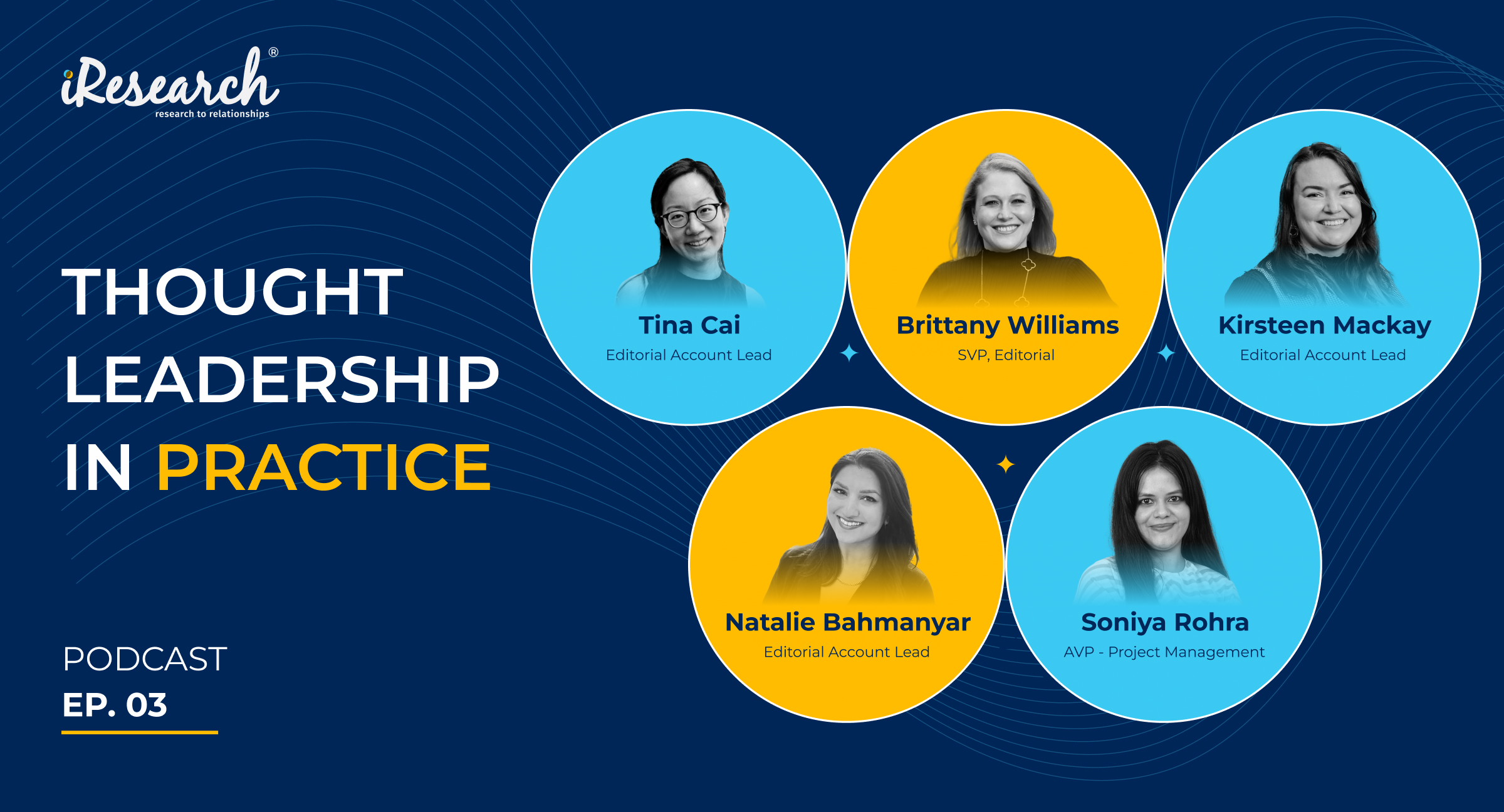
In this episode of Thought Leadership in Practice, host Brittany Williams puts those findings to the editorial team behind iResearch Services’ global study of 1,000 thought leadership professionals: Kirsteen Mackay, Natalie Bahmanyar, Tina Cai, and Soniya Rohra.
What follows is a candid, in-the-weeds conversation for anyone building—or trying to make sense of—a thought leadership function. Read the full TLiP 2026 report.
Key Takeaways
- Fragmentation is the default, not the exception: the average practitioner wears 2.7 functional hats, and 54% of organizations split budget ownership and strategy ownership across entirely different teams—even when a dedicated thought leadership team exists.
- Size doesn’t buy maturity: organizations with 100–200 employees are just as likely—sometimes more likely—to describe themselves as strategically mature as companies many times their size. Governance and process matter more than headcount.
- The video paradox: 50% of practitioners call video their best-performing format, ahead of podcasts (32%) and webinars (31%), but design and multimedia production rank among teams’ lowest reported capabilities, raising real questions about who can actually compete when it comes to production value.
- The confidence gap: 53% of individuals say they’re actively embracing AI, but that number drops to 43% at the organizational level and 33% at the industry level, a perception gap that can quietly stall the investment AI adoption needs.
Brittany Williams: Welcome to this episode of Thought Leadership in Practice, a podcast by iResearch Services about how professionals in this industry actually do their work—not in theory, but in practice. Whether you call it “thought leadership,” “strategic communications,” “content marketing,” “brand marketing,” “brand journalism,” or the like, we’re talking about the narratives that companies build to burnish their own reputations and that of their experts, into the minds and pocketbooks of their industry. My name is Brittany Williams, and I’m the Senior Vice President of Editorial at iResearch.
In June 2026, we released year two of our research on the thought leadership discipline, based on a quantitative survey of a thousand professionals from around the world. You can download the report now at iResearchServices.com. In this episode, we’re discussing the research—both the headlines and the ongoing stories behind the data.
Speaking of headlines… I’ve got my team on the line that produced this research and wrote it from start to finish. So I’d like to ask that team: what is a stat from this year’s work that you keep bringing up in conversation? What story do you like to tell? Kirsteen, why don’t you start us off?
Kirsteen Mackay: Thank you, Brittany. I’m Kirsteen, Editorial Account Lead at iResearch Services, and something I really like about this research that we do is that it gives us the real picture of who a thought leadership practitioner actually is, not an assumed profile or a synthetic profile.
With that in mind, one of my favorite findings this year is about the number of hats thought leadership practitioners are wearing—as in, the number of functional roles they’re shouldering. You know: program manager, marketer, editor, program sponsor—the list is very long. And in the report, we shared that the average thought leadership professional is wearing 2.7 hats simultaneously; four in five people wear two or more hats, and still more than half—52%, I believe—wear three or more hats.
Brittany: I imagine this is validating for people in the industry to hear who might feel like, “Wow, I’ve been asked to master marketing and editorial and research and, and, and, and…” It’s true. That feeling is validating.
Natalie Bahmanyar : We have no idea what that feels like.
Kirsteen: Yeah, no validation coming from these seats… (No, there’s heaps. Heaps).
So rather than thinking of a thought leadership specialist as someone who does one thing really well, we’re looking at a practice built on a lot of generalists and specialists, but who are ultimately spinning a lot of plates. What I find interesting about this stat is, unlike some of the other data in our research that I’m sure we’ll get into a bit later, the number of hats doesn’t really change by thought leadership maturity or investment in thought leadership.
Even well-resourced, strategically mature organizations have people wearing many hats. It only really shrinks or grows with headcount; the smallest organizations average about 3.6 hats per person; the largest is more like 2.5, which makes sense, right?
But it means that if you’re feeling stretched as a thought leadership practitioner, it’s not a sign that something’s gone wrong. It is kind of by design. It’s the nature of the thing.
Brittany: I think we found that too in other results, right? We asked about the individuals—so not only at the role level (“how many roles do you fulfil?”), but also “who owns the budget and “who owns the strategy at an organizational level?” And we ask those questions because we hear a lot of different answers in the field about who’s doing what, who they report to, and what those hierarchies look like. Natalie, do you want to jump in here?
Natalie: Yeah. Hi, everyone. My name is Natalie Bahmanyar, I am also an Editorial Account Lead at iResearch Services.
Building on what Kirsteen was saying, that fragmentation—and this is something that I found really interesting from the report—it’s not just about how many hats people wear, it’s showing up structurally too. Thought leadership as a whole sort of lives in the gray at most companies, which is something that I find really fascinating.
So, 54% of practitioners told us that budget ownership and strategy ownership for thought leadership sit in two totally different functions. And even when there is a dedicated thought leadership team (it’s only 36% of organizations to begin with), that team usually isn’t the one that’s calling the shots. It’s only 14% of those people that own the strategy, and 14% that own the budget.
So what I found really interesting—and what gets me about this every time—is that in this industry, everyone clearly knows that thought leadership matters, or they wouldn’t be investing in it at all. But a lot of organizations are still operating in a structure that puts them at a strategic disadvantage when the budget and the strategy sit in separate functions with no clear coordination. That’s exactly where misalignment creeps in.
And it does. It’s not that split ownership can’t work; it’s just that most organizations haven’t been intentional about it. So that accountability and ownership being scattered is something that I’ve consistently found to be really interesting, given the fact that we know how important thought leadership work is. And to your point, Kirsteen, does it mean that bigger, more-resourced companies have it figured out? This is where it continues to get interesting. If I can pass the baton to Tina, because you had some points about size and maturity…
Tina Cai: Thank you, Natalie, for teeing me up so beautifully. My name is Tina. I am another Editorial Account Lead on the iResearch team.
You’re right—I think when I was looking at the data, I had assumed that strategic maturity would roughly follow company size. Bigger companies have bigger budgets, bigger teams. It seemed like they’d probably also have the most mature thought leadership programs.
While the data does show that small organizations struggle, and that it’s difficult to achieve strategic maturity at a company with fifty people or less, we found that once you cross that threshold, organizations with just 100 or 200 employees were just as likely—or in some cases even more likely—to describe themselves as strategic than folks at organizations that were several times their size.
So I think, Natalie, complexity—and the type of complexity that you talked about—is part of the story here. As organizations grow, you have more stakeholders, more approvals, more competing priorities, more dotted lines, and more opportunities for things to fall between the cracks or to live in those gray areas between functions. And I think that’s why thought leadership is really a very cross-functional endeavor, as we’ve all found.
So one of my biggest takeaways is that strategic maturity isn’t about getting bigger; it’s about intentional governance and clear processes. And I actually think that’s a pretty encouraging finding, because it means that you don’t need to be in the Fortune 500 to be a strategic thought leadership organization.
Natalie: Yeah. If I can piggyback really quick on that, I think it’s important for us to ground the conversation that we’re having: The report that we put together defines thought leadership as “authoritative, insight-driven content meant to influence an industry, build credibility, and inform decision makers.”
That can look like white papers, reports, articles, opinions, opinion pieces—and some companies call it by other names, you know, content marketing, corporate comms, whatever. But to your point, it can sit with all kinds of different teams. And what we found is that it does, basically, at the end of the day.
Tina: Exactly. That was one finding that really challenged my assumptions. I’m curious about other results that you all found that may have surprised you.
Brittany: I can jump in for a minute, and maybe I can tee up another member of the team. But the complexity you highlighted, Tina, that’s really why we did the research in the first place. And Natalie, thank you for the definition.
We just did an event a few weeks ago in New York where we had more than one hundred thought leadership practitioners and executives, and we talked a little bit about the definition of thought leadership. And one of my takeaways of the day is that we still need to have that conversation about what this is, because it looks so different from organization to organization. You mentioned the organic growth that a lot of these thought leadership teams have taken—it often starts with one person recognizing the power of thought leadership and then bringing it into the organization. You have to have that champion in order to put something together across four or five different teams: marketing, strategy, the SMEs that are involved.
So, we really wanted to do this research in the first place to give a baseline and understand where people are operating, how they’re doing it, and how many people are involved. And I’ll be honest: one of my personal reasons for wanting to do year two of this research was that in year one, we found that the top format for thought leadership—not TikTok video, not B2C, but B2B thought leadership—is video.
And of course, we know not many B2B thought leaders are probably publishing on TikTok, (if you are, please leave a note in the comments; we’d love to hear what you’re doing). But we asked more questions this year about video, because that just seemed like such a contradictory investment to me, because video takes a crew sometimes, depending on what you’re doing. Maybe you’re doing motion graphics; it can take a budget. So we asked more questions on video, and Natalie, I think you were looking at these results recently, right?
Natalie: Yeah, I was. This is something that’s still incredibly fascinating to me, too—video being the top-performing format is still the one that I can’t stop bringing up.
Fifty percent of people, according to our data, who produce videos say that it’s their best-performing format, as you mentioned. And that’s ahead of podcasts, ironically (please continue listening to us) at 32%, and webinars at 31%. So that’s a substantive percentile difference there.
But what that raises for me is a resources question. It ties into all these different factors—maturity, all that stuff—too, but what I think about is the caliber of content that producers have to hit to make a video “top-performing,” versus what audiences are actually willing to consume, is a really interesting intersection to sit at. Because it makes me question, like, does that math work for everyone, or just the teams who can afford to make what consumers consider to be top-performing content? If a format that ‘wins’ is also the most resource-intensive one, that’s an access problem. You know, is it only the companies that are more mature from an investment standpoint or budget standpoint that have an equal shot at winning with video? Or is it consistent across the board that anyone has a fair shake at it?
Brittany: Oh, yeah. This year, we asked about budget—we were just looking at these numbers, too. And it’s a little bit what we expected, but a little bit not, because a much higher percentage of thought leadership producers are making video than I think I expected. But as you were just saying, some things correlate. Like, the bigger the budget in general, the more likely they are to do video, with podcasts having a slightly opposite correlation—the smaller budgets are a little bit more likely to produce podcasts. But everybody’s doing it—podcasts and videos. It doesn’t ever go to zero, even amongst the smallest organizations
Natalie: The thing that I’ll add, too, is that it also tracks from a design and production standpoint. So in our research, ‘design and multimedia production’ ranked as one of the lower capabilities that people consider to be important, and one of the lowest reported strengths.
So there is a real gap between what performs and what teams feel equipped to produce. So I’m going to hand it back over to Brittany or Tina, because I think we were all looking at different lines through this particular set of stats: If you can’t produce polished video, what’s the alternative? Is it podcasting? …We say, as we are on a podcast! What do you guys think?
Brittany: I mean, I think it’s somewhat about the mix of formats, right? Certainly what we found is that almost none of our respondents are only doing one thing. A lot of them are doing a combination of things. But you’re right, though—how much resource do you actually have to commit to the higher production-value things?
Another finding I saw in the data is that motion graphics and animated videos are more likely to be produced by larger-budgeted organizations. I mean, that makes a lot of sense. But talking-heads videos, everybody does those at almost equal rates across every level of budget. That is how people, I think, like to appear on LinkedIn in their videos.
So yeah, there’s a lot of connections to be made between our data and what is actually happening on the ground out there in the teams.
Natalie: Yeah. One of the things that we saw listed out as challenges people face is ‘time constraints’, which is not new information. But I think what we also see is that the marriage of time constraints and budget and resource issues, in this age of AI, very much leads to the inevitable creation of videos, or podcast material, using AI. Which I think opens up a really interesting conversation that, Kirsteen, you had some points you wanted to hit on.
Kirsteen: I’m really glad that you’ve broken the seal on the topic of AI and resources, because, you’re totally right. The top challenges and top capability gaps that practitioners identified were lack of internal skills, lack of time… lack of clear strategy also came up. And in terms of capabilities, practitioners identified content strategy and original research also among their biggest capability gaps.
All of this was in the back of my mind when I was looking at one of the questions we asked about AI—because it’s 2026, and we have to ask some questions about AI—was specifically about use cases within the development process. And I was really surprised to see how front-loaded it was. The highest numbers were, I think, 57% of our practitioners said they used AI for ideation. It then kind of tailed off—53% were using it in research, 45% in editorial production. It then kind of dips.
But my initial reaction to this was a bit of panic. Again, for context, we didn’t ask about intensity of AI use, or decision-making, or autonomy and we’re not saying that just because AI is involved in one of these stages, that it’s only involved in one of these stages and there’s no human intervention at all. But I think it’s important—and I’m going to deviate a little bit from the resources point—I think it is important that, yes, we should use the tools available. Our teams are stretched, we’re wearing many hats, responsibility is fragmented.
But at the same time, it brings me back to something that Oobah Butler, our wonderful keynote speaker at TLFT, was saying about stress-testing an idea—that his benchmark for if something is good, or his measure of if an idea is good, is first and foremost: does it inspire him? Does it interest him? Is he curious to see an idea brought to fruition? That’s stayed with me, and as I’m reading these ideation stats, for me the takeaway is that it’s really important to keep the human in the conversation—because ultimately, what are we writing thought leadership for? It’s not the search engines, it’s not the LLMs. If it was just for those, we would produce a different kind of content. But if we want to inspire people, and we want to elicit change in human behavior, keeping the balance and keeping an eye on those tools and the resources, but also making space for the human creativity and curiosity—is really important.
Okay, I am now just monologuing about AI and keeping humans in the loop. Somebody save me from myself.
Natalie: Well, I, for one, enjoy your melodic tones. But I will jump in really quick, talking about this human element of AI and human behavior specifically.
One of the AI stats that we asked about that I keep coming back to is the notion of receptiveness. The way that we asked it was how people are embracing AI, and then how their companies are embracing AI, and how the industry is embracing AI.
53% of individual people say that they are personally actively embracing AI. But when you drop that to their team, it’s 47%. When you go to their organization, it’s 43%. And then when you get to their industry, it’s 33%. So there’s a 20-point percentage gap between how people see themselves versus how they see other people.
And basically, what we’re seeing is that a lot of people are quietly embracing AI while assuming that their colleagues aren’t, or that their industry isn’t quite where they are.
So it’s not just people using AI out of curiosity—this is people being ahead of where they think their organization is, which can actually end up slowing things down. If everyone assumes that they are the exception, and that the industry, or their team is lagging behind, nobody pushes for the investment that AI adoption actually needs. And this is where I think we could potentially run into some issues around governance.
But I think, Tina, you had some additional points you wanted to make about receptiveness, before we get into everybody’s favorite topic of AI governance.
Tina: Yeah—maybe less ‘points’ and more ‘questions’, which I think is honestly true of this entire research for me. It’s funny that everybody thinks that they’re ahead of the curve, and it makes me wonder whether that’s reality, or whether that’s more of a perception gap. How much are we actually communicating to each other about how we use AI at work, and how enthusiastic we might be, or otherwise?
If I’m using AI every day, am I talking about it openly? Am I not sure exactly what my company’s policies are, or how my colleagues are going to react? So I think it’s a really interesting point in the AI adoption curve and the discourse.
And I think that this question reveals some really interesting potential gaps in not just in how we govern AI usage, but in how we talk about it and signal it to others.
Soniya: My name is Soniya, and I work with editorial, doing the project management. And speaking of AI governance—we expected this conversation to be pretty immature across the board, but AI is moving really fast and the data told us a different story.
It turns out 64% of organizations already have a formal AI policy in place—higher than we expected, honestly. And the real surprise wasn’t that governance exists, it’s how unevenly it’s spread. Among strategic organizations, there are 76% who have a policy, and ad hoc organizations, just 58%. So it’s not that the whole industry is behind, it’s that maturity and governance move together, almost in lockstep.
And here’s the part that really stuck with us: fixing this gap isn’t actually hard. It’s not a resource problem, and it’s not a 40-page-policy problem. It really just comes down to answering a few practical questions: what do we disclose in AI, or what’s the AI involvement?How is someone accountable and who is accountable if something goes wrong? The fix is available, literally, to every organization, no matter its size or maturity level.
Brittany: I think it’s clear that, it needs to be more than just a policy document. It has to be a living, breathing, governance strategy.
Kirsteen: Yeah. I think the AI conversation, while it feels like it should be at its peak right now, we don’t know. We don’t know if it is. Everybody’s talking about AI, and maybe in six months we’ll be onto the new thing, or the developments will be so far ahead that what’s interesting today is chip paper tomorrow.
So next year’s survey, we will see—maybe we’ll have a bunch more AI questions, maybe the world will have moved on, or maybe we will be surprisingly close to where we are now. There are a lot of things up in the air for next year that I think we’re all curious about.
Tina: what’s one thing on your mind that we couldn’t fully answer this year, or that you’d like to explore more deeply, or in a different way, next year?
Tina: I’m really excited to dig deeper into distribution and channels next year. This year we found that LinkedIn was not only one of the most commonly used channels, obviously, but it’s also one of the highest-performing channels—nearly half of the respondents who use LinkedIn said that it delivers their best ROI across all of the different channels that they use.
I think that makes a lot of sense. Obviously, thought leadership is about connecting experts with people who are looking for expertise, and LinkedIn is where those conversations naturally happen. But as platforms evolve, as algorithms change, as our behavior shifts, I think that we’re finding things like video, and podcasts like this one—hopefully—are gaining traction and becoming really important mediums for thought leadership.
So how does that play out with LinkedIn as a distribution channel? Do we think of LinkedIn as a place to watch video or listen to podcasts, or are we moving on? And I think AI—which I know we’re trying to close the book on, but we’re never finished with AI, right?—how does AI-powered search, and new platforms and new formats, start reshaping the distribution landscape? I think this is one of those conversations that’s going to continue to evolve, and that we’ll need to keep a pretty close finger on the pulse of, to get ahead of it.
Brittany: Yeah, I mean, I’ll chip in that I just posted on LinkedIn today about this LinkedIn format data—in a bit of a meta, especially talking on a podcast, about a podcast, on a podcast (how many mirrors are there around us?) But it’s fun to do research on thought leadership and then publish thought leadership on that thought leadership, I will say, because you really do get to test out: are we in the post-social-media age?
And I’ll say, a lot of the attention that we’ve gotten so far on this report has been through LinkedIn. That’s partly because you’re talking directly to individuals, and we’re also using our own individual platforms on LinkedIn to reach our networks.
I think the question in my mind right now is: with the uptick in bot activity, LinkedIn is super noisy now. It’s harder to find the signal in it. Are people going to start abandoning those more broadcast social media channels, and continue to get their information more and more from the few narrowcast sources that they’ve got—whether that’s their chat, group chat, or just the individuals in their network? Either way, this conversation of how an organization create a conversation that individuals want to be a part of requires the individuals to be a part of it from beginning to end.
And that’s part of what our research found, too. We asked about when you start planning distribution, for example, and only a third of respondents start planning it before they’ve done the research—which means a lot of folks are out there fielding research, and even writing it, and getting it all ready to go—all the way up to the end—before they’ve talked to anybody about what formats or what uses they have for those pieces of thought leadership.
If you want to ask about the difference between more ad hoc operations and more strategic ones, for example, one of the things that they do is they connect the beginning to the end of their research efforts, and they create a kind of circle of the conversation and the narratives that their brand can have standing to talk about—whether that’s financial strategy, or environmental policy updates, or whatever it is for your organization, the conversations that they should be a part of. Your distribution needs to put you in front of the right audiences.
So social media, LinkedIn, is the hot thing right now. Will it be when we field this survey next year? I don’t know. But LinkedIn has quite a hold right now on a lot of this thought leadership conversation, and it’s where a lot of that conversation actually happens.
Soniya, speaking of where the conversation happens, I’d love to bring you in—you were looking at our gating data, right?
Soniya: So we asked organizations a pretty fundamental question: do you gate your thought leadership content? And the answer for almost half of them, is: it depends. Forty-eight percent took a mixed approach—some content behind a form, some freely accessible—and about a third, 34%, leave most of it open. Thirty percent gate pretty much everything.
But here’s where it gets interesting: ad hoc organizations—the least mature—are actually the most likely to leave content ungated. Which makes sense—if you’re still building your reputation, reach probably matters more than lead capture right now.
Just one nuance: professionals who say content strategy is their biggest strength lean toward gating more, but professionals who say storytelling or design is their strength, they are more likely to leave it open, which tells you something about how people think about the content: is it actually for conversion versus the connection?
Brittany: I went to journalism school twenty years ago now and, at the time, they were telling me that newspapers were dying, and then the news industry was dying. Yet you still study storytelling. I’ve always believed in the power of words. I think in this age of AI, that’s only becoming more important as the amount of content is ramping up.
And I feel like we’ve been talking about that. “The internet changed everything” is my least favorite lead to any thought leadership piece ever (and I am guilty, I’ve written that lead in a lot of different forms).
We’re looking at an industry that’s really still forming. But truly, I mean, when everyone’s telling you your industry is dying, and your industry is storytelling, where do you go? You go look for jobs in organizations that have a budget to do research and to do storytelling. And there are more and more organizations out there offering those kinds of things. That’s actually one of the reasons we brought students to our most recent event—because, gosh, I didn’t know what thought leadership was when I went to journalism school all those years ago.
This is a podcast, so you can’t see my colleagues all nodding. We found in our data, too: only fifteen of the thousand people we talked to have been in the industry for more than twenty years; 80% have been working in thought leadership for two to ten years, which I think tells you where we are. I’ve been working in it for around fifteen to twenty years—so on the longer end. I think all of us have notched some tenure at this point. And we still have conversations at the beginning of many calls educating people about what thought leadership is, and how it fits into a strategy.
More people probably call it strategic communications, or content marketing—but to me, they’re not mutually exclusive, they’re not all that different. It’s just a matter of how your organization has come around to understanding storytelling about your brand and your products—but not advertising; not specifically about that. There’s this spectrum: on one side is advertising, and on the other side is really pure research, just for the good of the world and for getting it out there.
The kind of B2B custom research and storytelling that we do lands somewhere in that spectrum. We’re always trying to pull our clients and our storytellers over to: what are the most interesting questions that your industry is dealing with right now? Ask those. You don’t want to ask questions about who uses your product—that’s a consumer survey. What we’re talking about is the bigger stories.
To me, there are so many more questions still to ask as we watch this discipline, this function, form across the different industries. We have some examples—like the consulting firms that have done it for decades, generations now—but most haven’t been doing it that long. So what can we learn?
I’ll use this as my platform for our final question of the podcast: what is something that you wish more people understood about how thought leadership actually works in practice? We’re talking about a relatively young function and industry. I’ll open the floor. Anyone got a thought: what does the passion in you want to communicate out to the world about this thing that we’ve dedicated our careers to at this point?
Natalie: For me, it’s throughlines. The process that you engage with, from pre-research all the way to distribution and measurement, needs to actually connect.
That’s the big thing that I think often gets misplaced when it comes to strategic thought leadership planning. It’s not just—and we’ve seen this with what we’ve talked about today, with distribution, the stuff that’s in the report—it’s not just “think about distribution after you make the content.” It’s shaping your research, your hypotheses, the way that you set up a survey or a qualitative questionnaire, the way that you write your report—it’s shaping all of that so that you set up the distribution and the headlines that you’ll actually need later. You have to think about all of that from the get-go, and you have to make sure that it all is kind of like a baton race. It each hands off to the next stage in your process.
And, again, we’ve talked about how distribution gets treated like an afterthought at most organizations, but that sequencing has real consequences, right? Teams that put distribution as an afterthought on the end are stuck retrofitting content, after something is finished, into a channel it was not necessarily built for. And that’s when we run into all the different issues—you’re not building an asset to succeed there in the first place, whatever platform you’re using.
So it’s a lot of mix and match, a lot of figuring out what your audience wants to see and where. And that’s totally fine, that there’s not one formula for everybody. But there are components that clearly move the needle, and planning for distribution early is one of them. And when I say planning for distribution—it’s a best practice.
And it’s not just about the distribution. One of the things that we’ve seen as a team is a lot of times, we’ll do a survey with a client, and they’ll come back with the survey results and say like, “Well, we really wanted to get at this point.” And it’s like: you have to talk about those things before you draft the questions, because then you’re not answering the questions you want answers to, if you don’t think about all of that ahead of time.
Kirsteen: This taps into something I won’t dwell on, but, when I was looking through the various hat-wearing characteristics, ‘subject matter expert’ is the most-worn hat of our cohort, and writer and editor is the least-worn hat of our cohort.
So when you’re talking about throughlines, okay, we’re talking about strategic narratives, or, strategic consistency, not just storytelling narratives—but it’s interesting to me: where are the writers? I mean, are they all just on this podcast?
It’s interesting to me that last year, good writing and storytelling was one of the most important attributes of good thought leadership. And I think that this is the reason why we do our Thought Leadership for Tomorrow Awards as well (shout out)! It’s all integrated—that story feeds into the distribution.
The sooner you think about the end, the more it ties together and becomes a kind of beautiful, connected initiative, rather than a disjointed project that doesn’t quite deliver on anything because it’s spread too thin across everything. I dwelt on that more than I meant to.
Natalie: Here’s what I’ll say about that: I’m going to throw in a shameless plug and say that if you’re listening to this, and you have no idea how to go about doing those things—about developing your throughlines, or figuring out where to put your content, where you got to start—that’s generally the kind of thing that we do.
So that’s us. Download the report, get in touch, find us on LinkedIn. This is not quite the end of the podcast, but that’s what we’re here to help with, and that’s why we’re talking about this to begin with.
Brittany: I’ll just show myself out as the host. Natalie, you just earned yourself another hat, girl.
Natalie: Love it. But yeah, it is a shameless plug, but it’s also true. To your point, Kirsteen, this is where the writers are.
We’re not necessarily working for a dedicated thought leadership company where we’re writing stuff for one specific brand. But a lot of us, because we wear so many different hats, work in organizations like this, where we get to wear our jack-of-all-trades hat and be of assistance to folks who are still finding their footing, or to people who are very well versed and just don’t have the capacity to reach the magnitude that they want to reach. So even if you’ve just got questions, we are here to help.
Brittany: Well, thank you everybody so much for this conversation. I could keep this podcast going for another hour, but we actually asked about the length of podcasts, and it turns out you want a podcast to be about the length of a commute. So we’re going to cut it off here.
Thank you so much for listening. We are just getting started—if you’d like a custom look at this data, we’d be delighted to talk about any of this, and more, as it applies to your specific context.
In fact, we are looking for individuals to participate in ongoing qualitative interviews as part of our research. So if you work in thought leadership, we want to hear what you think. Email us at editorial@iresearchservices.com.
I’m Brittany Williams. Thanks again. Until the next episode.