

Retail banks face mounting pressure to lead the shift toward sustainable finance or risk losing relevance in an increasingly climate-conscious market. But despite 54% of consumers believing their banks should prioritize sustainability, only 22% consider it a key factor when choosing a provider, leaving financial institutions grappling with how to balance environmental responsibility with customer expectations.
This article looks at the challenges and opportunities in sustainable banking, from navigating complex regulations and mitigating greenwashing risks to leveraging technology for greater transparency.
As global temperatures hit their 15th consecutive record-breaking month, retail banks face a stark choice: lead the charge on sustainable banking or risk becoming obsolete in an increasingly climate-conscious market.
While 54% of consumers surveyed believe their bank should focus more on sustainability issues, only 22% prioritize sustainability in their banking choices—creating a complex challenge for financial institutions trying to balance making a positive environmental impact with anticipating customer needs. It’s a tall order.
The environmental impact of retail banks reaches far beyond their operational footprint, giving retail banking both a responsibility and an opportunity to influence sustainability efforts and help other sectors maintain momentum. Through strategic capital allocation, banks can direct funding to sustainable initiatives or, conversely, perpetuate investments in unsustainable practices both within the financial sphere and across other industries.
In this post—the final in our series on the three T’s of financial services—we offer practical insights into the barriers sustainable banks are facing.
The landscape of sustainable banking
Figure 1. Sustainable banking milestones
Green banking products and services are neither new nor revolutionary, but uptake is growing. In 2016, the UN Environment Programme reported a budding consumer interest in sustainable investments, which, according to McKinsey, has blossomed into almost 40% of US consumers showing an interest in climate-linked financial products by 2023—a clear sign of increasing demand for options that align with personal values.
Meanwhile, a number of regulatory measures and frameworks, like the Partnership for Carbon Accounting Financials (PCAF), are helping banks standardize how they measure and disclose emissions tied to their lending and investments, making climate impact more transparent (Figure 1).
This evolution is most evident in the operational shifts within the sector, as retail banks of all stripes undertake significant internal changes to keep up with digital advancements. By optimizing processes and deploying energy-efficient technologies, banks are reducing their own carbon footprints while also enhancing customer engagement through digital (rather than paper) channels. This transformation has been spurred on by an explosion of online-first financial services providers, which are challenging financial institutions to modernize or get left behind.
Three barriers to sustainable banking
Banks pursuing sustainability face three interconnected challenges that demand immediate attention: complex regulation and governance, wavering consumer demand, and greenwashing risk.
Complex regulation and governance
The regulatory landscape for sustainable banking has become a maze of competing standards, with a 155% surge in global ESG regulations since 2013 and more than 1,250 new rules introduced worldwide, according to ESG Book. This fragmented approach—with the European Union taking a regulation-forward stance while the US maintains one of minimal legislation—creates significant compliance challenges for cross-border operations. Furthermore, the extent to which the standards translate into progress on sustainability objectives has yet to be thoroughly explored.
And, unfortunately, climate goals are proving easier to pledge than achieve.
A March 2024 study from the Science-Based Targets Initiative (SBTi) revealed that hundreds of businesses that joined the Business Ambition for 1.5C campaign in 2019 have withdrawn their commitment to set verified net-zero targets. The primary obstacles, according to organizations that participated, include understanding Scope 3 emissions (54%), the absence of a published net-zero standard (27%), the abstract nature of net-zero goals (22%), and potential conflicts with regulatory frameworks (18%).
Sustainability initiatives and regulations are intended to catalyze action and promote accountability. But their complexity can create a compliance burden and pose challenges in consumer communication, increasing the risk of oversimplification, unclear claims, and potential greenwashing.
Despite these obstacles, pressure for greater transparency about sustainability practices is being applied from multiple directions. In a recent Deloitte study, financial services executives ranked key stakeholder groups as the top sources of pressure, including boards (53%), ESG rating agencies (49%), and customers, consumers, and clients (38%). It remains to be seen how the collective desire for action from these core groups impacts progress for financial institutions engaging in sustainability efforts.
Wavering consumer demand
Consumers generally want their banks to be thinking environmentally. In the iResearch Services Retail Banking Survey 2023, more than half (54%) of consumers said their bank should focus more on ethical and sustainability issues.
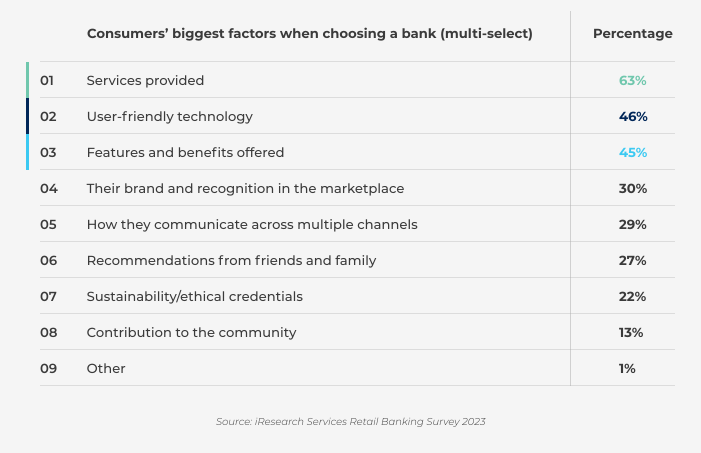
But they’re not consistently putting their money where their mouth is; only one in five (22%) place sustainability and ethical credentials among their top considerations when choosing a bank (Figure 2). Rather, almost two in three consumers choose a retail bank first and foremost based on the services the bank provides.
Figure 2. Bank selection criteria
This disconnect reflects broader economic pressures. During periods of inflation, political flux, and a cost-of-living crisis, consumers often prioritize immediate financial concerns over environmental impact. In fact, a multi-year consumer study spanning 2021 to 2023 by Deloitte found declining trends in both sustainable behavior and climate change concerns.
Consumers may also be struggling to have total confidence in banks’ commitment to genuine sustainability when it’s difficult to evaluate the difference between regulatory demands, authentic action, and bold marketing claims, as investigated in a 2024 study by the Economic and Social Research Institute in Dublin.
Greenwashing risk
Despite fluctuations in consumer buy-in, international commitments—such as the Paris Agreement and UN SDGs—mean that sustainable finance remains a business imperative. As such, banks may be tempted to overstate (or understate) the environmental impact of their products or practices to attract eco-conscious customers.
Greenwashing poses a significant risk to the credibility of retail banking. According to a 2023 iResearch pulse survey, 87% of financial services leaders acknowledge the prevalence of greenwashing in the industry. And a 2020 European Commission study revealed that 53% of environmental claims it investigated in the EU were vague, misleading, or unfounded.
The consequences of greenwashing are far-reaching. Beyond damaging customer trust and brand loyalty, it attracts heightened regulatory scrutiny—increasing reputational and legal risks and potentially even limiting an organization’s access to capital. Perhaps most concerning is how greenwashing undermines legitimate sustainability efforts by fostering skepticism toward green claims.
The future of sustainability in retail banking
Figure 3. The 3T’s of Financial Services
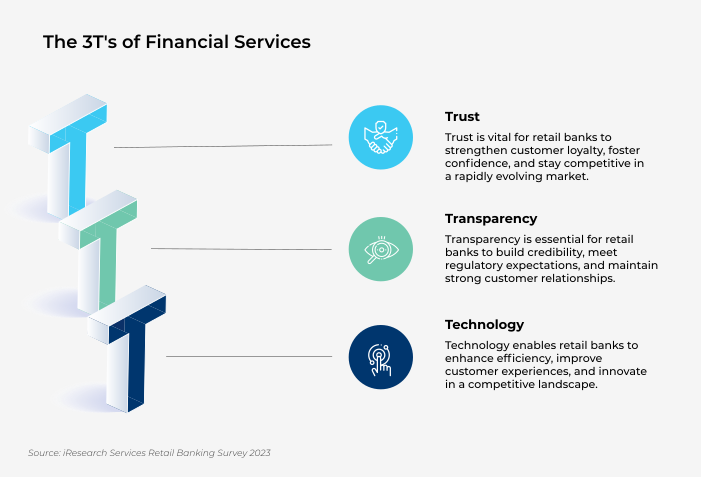

The future of sustainability in retail banking—and arguably the broader economy—depends on the 3T’s: Trust, Transparency, and Technology.
Trust
In retail banking, sustainability and consumer trust go hand-in-hand. But amid greenwashing concerns, this trust remains fragile among the growing number of customers who expect their banks to act responsibly toward the environment. As McKinsey’s 2022 study highlights, transparent communication is essential for strengthening loyalty and brand reputation among eco-conscious consumers.
Transparency
As the regulatory landscape shifts, financial institutions are required to provide more detail about their environmental impact, emission reduction targets, and sustainable products. Banks must stay ahead of evolving standards and demonstrate their environmental impact accurately and authentically to avoid greenwashing accusations.
Technology
Digital transformation enables retail banks to simultaneously improve customer experience, streamline operations, and reduce their environmental impact. But they may be able to go further still; a survey by Tink in 2023 found that 40% of UK consumers want their bank to provide tools to help them understand and manage their own carbon footprint. Open banking-enabled fintech partnerships offer a world of possibilities for new financial products and services that drive widespread sustainable action.
Conclusion
Sustainable retail banking empowers consumers to make environmentally responsible financial choices, and is essential for building a greener, more ethical economy. At the same time, it reduces regulatory risks and lowers operational for banks, while building reputation and long-term resilience.
For banks to continue evolving, trust and transparency are crucial for reassuring customers that their money supports genuine positive change. Technology also plays a key role in providing data-driven insights for sustainable investment options.
Together, these pillars—trust, transparency, and technology—help retail banks champion environmentally conscious choices and contribute to a sustainable future.
Retail banking has long had the power to directly connect consumers with a more sustainable financial future. By aligning products and processes with environmental goals, banks can become powerful forces for positive change—one responsible transaction at a time.
