

Imagine a bank vault made of glass—a striking symbol of transparency that lets customers glimpse not just where their money is stored but how it’s managed. Today, banking customers demand the same clarity in the digital realm. In fact, over 76% of consumers say they’d consider switching banks for clearer, more personalized communication—a wake-up call for the financial sector.
In this article, we explore what true banking transparency looks like in the 21st century, from the power of personalized communication to the enduring value of in-person service.
Imagine if bank vaults were made of transparent glass. Passersby would press their noses against the windows, captivated by the daily dance of deposits and credits; the meticulous sorting of bills; the whirl of cash, coins, precious metals, and important documents. Danny Ocean would begin recruiting a heist crew immediately.
As fascinating as this transparent vault would be, it would still reveal only a fraction of a bank’s true financial workings. The vast machinery of modern banking extends far beyond the confines of any single building, into the digital realm and the complex web of global finance. In an age where data flows as freely as currency, customers increasingly demand clarity not just about where their money is stored, but how it’s used, invested, and protected.
The iResearch Services Retail Banking Survey 2023 found that a bank’s success in achieving higher levels of transparency can have a profound impact on customer satisfaction and loyalty. In fact, over three-quarters (76%) of respondents would consider switching banks based on better, more personalized communication—a stark reminder of the power of openness in today’s financial landscape.
But what does true banking transparency look like in the 21st century? How are banks performing in their efforts to communicate clearly with customers? And what do customers really want when it comes to understanding their financial partners?
In this article, we’ll crack open the opaque vault of banking transparency, with a focus on how banks communicate with their customers—and whether customers are satisfied by the information they receive.
Checking in builds interest
While the majority (66%) of consumers believe their bank currently does a good job of communicating with its customers, this leaves at least a third wanting more. Of those that took part in our global survey, customers in Greece (87%) and the Nordics (79%) are most likely to express satisfaction, while those in France (48%) and Italy (52%) are the least likely (see Figure 1).
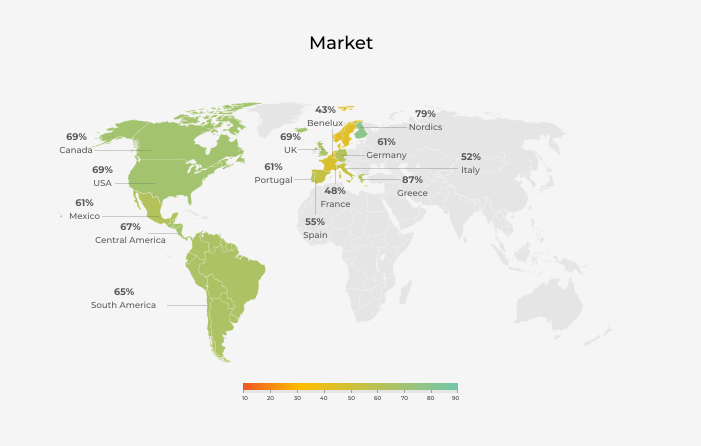
Figure 1. Proportion of respondents who believe their bank currently does a good job of communicating with customers
The importance of effective communication cannot be overstated when it comes to customer retention. Our survey reveals a striking willingness among consumers to switch banks for better, more personalized communication (see Figure 2). This is especially true for younger customers—80% of 18- to 24-year-olds in our survey would consider switching—but this trend spans all generations. We see a small spike among those aged 55 to 59, possibly as they address their finances before approaching significant financial milestones like paying off a mortgage or preparing for retirement.
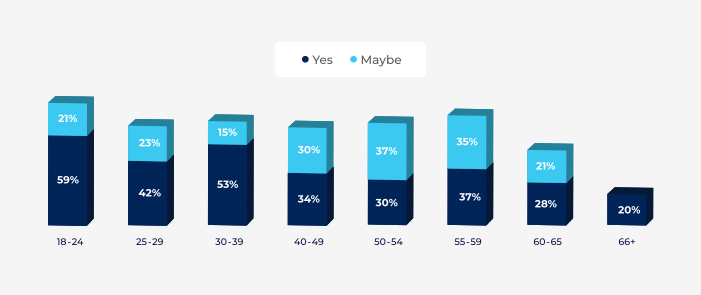

Figure 2. Consumers who responded “yes” or “maybe” when asked whether they would consider switching banks based on better, more personalized communications
Understanding customer needs—and proving it
So, how can banks do more to reach these customers? The iResearch Services Retail Banking Survey 2023 suggests it may take more than a snappy new jingle.
When asked how banks could best improve their customer communication, respondents showed a clear preference for approaches that demonstrate an understanding of their needs. Over half (54%) indicated a desire for their bank to explain how it is actively helping customers—an act of transparency—and 51% believe their bank could benefit from connecting with customers on a more personal level (see Figure 3).

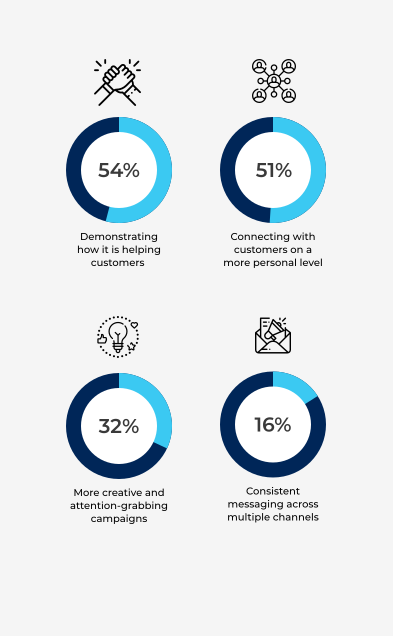
Figure 3. From the following options, how can your bank best improve its customer communication?
Thankfully, marketers have more tools than ever to forge such connections and share both substantive and creative messaging campaigns. Younger consumers, in particular, want to see memorable, attention-grabbing campaigns (see Figure 4). Nearly half of respondents aged 18 to 29 think more such campaigns would improve banks’ communications.
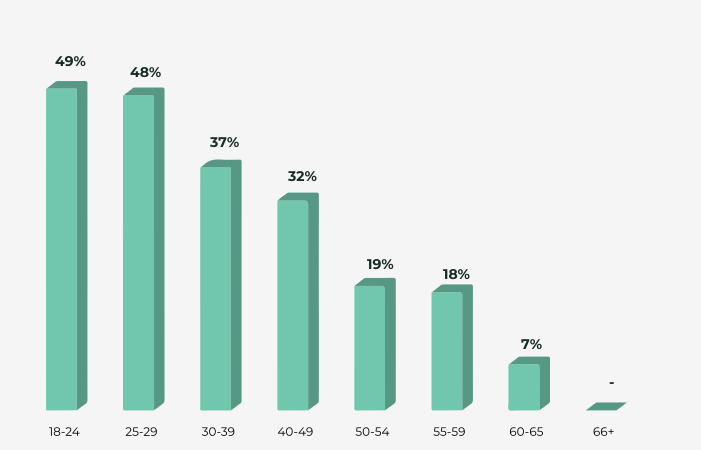
Figure 4. Respondents who believe their bank can best improve its customer communication by using more creative and attention-grabbing campaigns.
Putting the ‘face’ back in interface
Face-to-face interactions are a huge opportunity for transparent communications between banks and customers. In an era where flashy slogans and theatrical ad campaigns often dominate, there’s still no substitute for genuine human connection.
PwC reports a net decline of 12 retail outlets a day across Great Britain over the first half of 2024, and Cushman and Wakefield expect 500 retail store closures (net) in the US by year-end. Retail banks are struggling too; at least 292 Lloyds, Halifax and Bank of Scotland branches are expected to close in 2024/2025, in addition to 248 net location closures for US Bank, JPMorgan Chase, Comerica Bank, PNC Bank and Wells Fargo collectively across this financial year so far. But consumers still value having a physical bank presence. According to the iResearch Services Retail Banking Survey 2023, only 15% of respondents reported that they no longer visit a bank branch in person (see Figure 5).
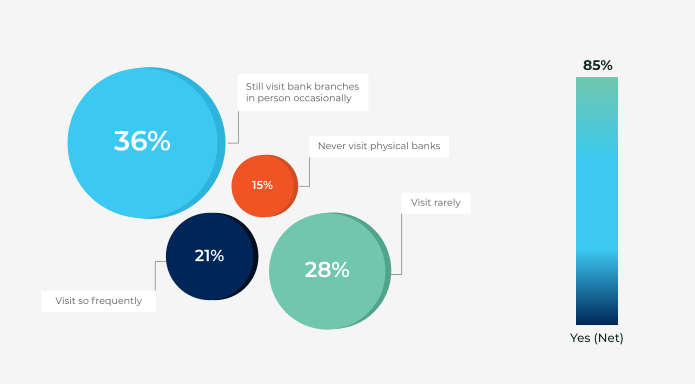
Figure 5. Do you still visit bank branches in person?
One might suppose older generations frequent bank branches more than younger ones, but our research challenges this assumption: 97% of 18- to 24-year-olds report using branches to some extent, and in-person visits remain relatively high across all age groups—declining only slightly with age (see Figure 6).


Figure 6. Bank visitation by age group
This highlights the persistent value of in-person customer service, and how important it is that—despite a struggling retail sector—banks can keep strategic local branches open to foster communication, transparency, and trust. Much like our imaginary transparent vault, physical branches offer a tangible connection to the bank’s operations, allowing customers to see and interact with the human side of banking. Accenture’s 2023 Global Banking Consumer Study reveals similar insights: 63% of consumers surveyed liked seeing branches in their neighborhood, and 67% turned to the branch to solve complex problems.
Data transparency: The digital vault
Just as our transparent vault concept raises security concerns—and flushes Danny Ocean with excitement—so too does the vast amount of data collected by banks make customers uneasy, without underlying excitement. Almost one in five (19%) express discomfort about sharing their data with financial service providers.
Banks need to make their data vaults as reassuringly transparent as our glass vault. Signposting technical protocols like encryption, multi-factor authentication, and biometric features is one option. Sharing incident response plans and educating customers on safe online practices can also go a long way to build trust.
Enhancing transparency in retail banking
Communication is at the core of transparency, and the iResearch Services Retail Banking Survey 2023 finds that retail banks may need to refocus their efforts to connect with marginal customers—or risk losing them to a competitor.
Strategies for achieving this goal can include:
